> For the complete documentation index, see [llms.txt](https://vesta-guide.gitbook.io/vesta-guide/llms.txt). Markdown versions of documentation pages are available by appending `.md` to page URLs; this page is available as [Markdown](https://vesta-guide.gitbook.io/vesta-guide/vesta-354.md).
# VESTA-354
TSP-1-BUS
## Touch screen Keypad on BUS
## **1. Identifying the Parts**
## **2. Package Content**
Touchscreen Keypad \*1 Mounting Bracket \*1 Machine Screw \*1
Self-tapping Screws for Mounting Bracket \*2 Wall Plugs for Self-tapping Screws \*2
## **3. Power Supply**
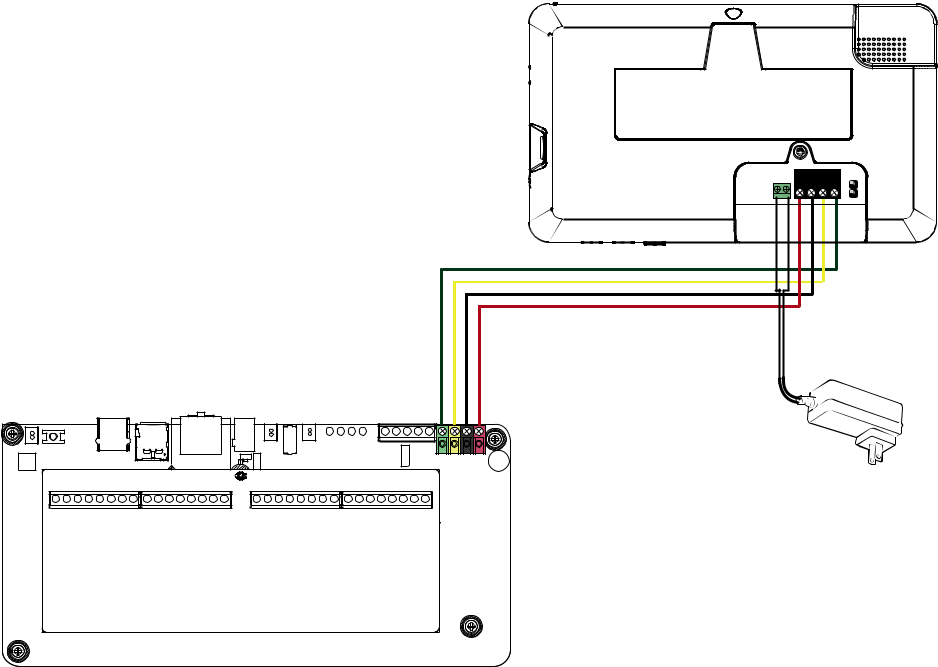
TSP-1-BUS can be powered by either the Hybrid Panel via BUS connection or the external power supply via the 12V AC-DC adaptor.
## **4. Equipment required**
A router supporting 2.4 GHz Wi-Fi network is required for “WIFI” or “WIFI & BUS” operation. The Hybrid Panel should be connected to this router with access to the Internet.
## **5. Bus Wiring of Touchscreen Keypad**
Before connecting the Touchscreen Keypad to the system bus, please switch the power off.
To assist with cable connection, the terminal blocks on each BUS module are color-coded.
TSP-1-BUS will be automatically turned on after
power is supplied.
## **6. Setup and Connection**
TSP-1-BUS can operate in three different modes: “”WIFI & BUS”, “WIFI”, or “BUS”.
Learning Process is only required for the first-time setup.
{% hint style="warning" %}
**Please make sure you update TSP-1 to latest fimrware version before start.**
{% endhint %}
**Step 1.** After TSP-1-BUS is wired to the Panel, select the language and then connection mode for the Keypad.
**Step 2. For “WIFI & BUS” and “WIFI” connection,** select the WIFI SSID of the router to which the Panel is connected.
Enter the WiFi network password if required and click “OK”.
**For “BUS” connection**, you will enter the Home page directly.
**Step 3.** Put your Hybrid Panel into learning mode (refer to Panel’s user manual for details).
**Step 4. For “WIFI & BUS” and “WIFI” connection,** your Touchscreen Keypad will automatically search for available Panels. Select the Panel you’d like to access.
**For “BUS” connection**, the Touchscreen Keypad will be automatically displayed on the Panel’s webpage.
**Step 5.** On the Panel’s webpage, click “**Add**” to include the Touchscreen Keypad into the Panel.
**Step 6.** The Touchscreen Keypad will be displayed as Keypad in “Learned Device” section if the learning is successful.
## **7. Hardware Installation**
The Touchscreen Keypad is designed to be mounted on the wall with the wall mounting bracket provided.
**Step 1.** Use the two mounting holes on the bracket as a template to drill holes into the wall to be mounted.
**Step 2.** Insert the wall plugs if the Keypad is to be fixed onto plaster or bricks.
**Step 3.** Screw the bracket onto the wall with the 2 screws provided.
**Step 4.** Attach the Touchscreen Keypad onto the mounting bracket.
**Step 5.** Tighten the machine screw to firmly fix the Keypad onto the mounting bracket.
**For more detailed instruction, please scan the QR Code and download “TSP-1-BUS Touchscreen Keypad Installation Guide”.**


